| One Art, Elizabeth Bishop |
The art of losing isn't hard to master;
so many things seem filled with the intent
to be lost that their loss is no disaster.
Lose something every day. Accept the fluster
of lost door keys the hour badly spent.
The art of losing isn't hard to master.
Then practice losing farther losing faster:
places and names and where it was your meant
to travel. None of these will bring disaster.
I lost my mother's watch. And look! my last or
next-to-last of three loved housed went.
The art of losing isn't hard to master.
I lose two cities lovely ones. And vaster
some realms I owned two rivers, a continent.
I miss them but it wasn't a disaster.
Even losing you (the joking voice a gesture
I love) I shan't have lied. It's evident
the art of losing is not too hard to master
though it may look like disaster.Etiquetas: Literatura |
|
|
|
| Tom Clancy, Ordenes Ejecutivas.- |
| Un sistema corrupto se corrompe constantemente, y la lógica del terror llega a la conclusión lógica: el humilde conejo acorralado por el zorro no tiene nada que perder si intenta defenderse… y los conejos tienen dientes… y a veces, hasta tienen suerte. Etiquetas: Literatura |
|
|
|
| Neruda |
| "Muere lentamente quien no voltea la mesa cuando está infeliz en el trabajo, quien no arriesga lo cierto por lo incierto para ir detrás de un sueño, quien no se permite, por lo menos una vez en la vida, huir de los consejos sensatos” Etiquetas: Literatura |
|
|
|
| Primavera de Praga, 1968.- |

The Ogre does what ogres can,
Deeds quite impossible for Man,
But one prize is beyond his reach:
The Ogre cannot master speech. About a subjugated plain,
Among it's desperate and slain,
The Ogre stalks with hands on hips,
While drivel gushes from his lips.
W. H. Auden. Etiquetas: Literatura |
|
|
|
| Rayuela, Julio Cortazar, Capitulo 28. |
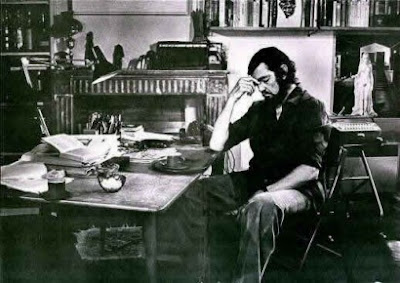
-Vamos, dejá la poesía para otra vez. De acuerdo en que no hay que fiarse de las palabras, pero en realidad las palabras vienen después de esto otro, de que unos cuantos estemos aquí esta noche, sentados alrededor de una lamparita.
-Hablá más bajo -pidió la Maga.
Sin palabra alguna yo siento, yo sé que estoy aquí -insistió Ronald-. A eso le llamó la realidad. Aunque no sea más que eso.
-Perfecto -dijo Oliveira-. Sólo que esta realidad no es ninguna garantía para vos o para nadie, salvo que la transformes en concepto, y de ahí en convención, en esquema útil. El solo hecho de que vos estés a mi izquierda y yo a tu derecha hace de la realidad por lo menos dos realidades, y conste que no quiero ir a lo profundo y señalarte que vos y yo somos dos entes absolutamente incomunicables entre sí salvo por medio de los sentidos y la palabra, cosas de las que hay que desconfiar si uno es serio.Etiquetas: Literatura |
|
|
|
| Death of a saleman, Arthur Miller. |
"I run out of that building and I see... the sky. I see all the things I love in this world. The work, the food, the time to sit and smoke. And I look at this pen and I ask myself, "What the hell am I grabbing this thing for? Why am I trying to become something I don't wanna become when all I want is out there waiting for me the minute I say I know who I am?"
Biff Loman (John Malkovich, excelente en la pelicula)
Etiquetas: Cine, Literatura |
|
|
|
| Nuestro pobre individualismo, Borges, 1946.- |

Las ilusiones del patriotismo no tienen término. En el primer siglo de nuestra era, Plutarco se burló de quienes declaran que la luna de Atenas es mejor que la luna de Corinto; Milton, en el XVII notó que Dios tenía la costumbre de revelarse primero a Sus ingleses; Fichte, a principios del XIX, declaró que tener carácter y ser alemán es, evidentemente lo mismo. Aquí, los nacionalistas pululan; los mueve, según ellos, el atendible o inocente propósito de fomentar los mejores rasgos de los argentinos. Ignoran, sin embargo, a los argentinos; en la polémica, prefieren definirlos en función de algún hecho externo; de los conquistadores españoles (digamos) o de una imaginaria tradición católica o del “imperialismo sajón”.
El argentino, a diferencia de los americanos del Norte y de casi todos los europeos, no se identifica con el Estado. Ello puede atribuirse a la circunstancia de que, en este país, los gobiernos sueles ser pésimos o al hecho general de que el Estado es una inconcebible abstracción; (1) lo cierto es que el argentino es un individuo, no un ciudadano. Aforismos como el de Hegel “El Estado es la realidad de la idea moral” le parecen bromas siniestras. Los films elaborados en Hollywood repetidamente proponen a la admiración el caso de un hombre (generalmente, un periodista) que busca la amistad de un criminal para entregarlo después a la policía; el argentino, para quien la amistad es una pasión y la policía una mafia, siente que ese “héroe” es un incomprensible canalla. Siente con don Quijote que “allá se lo haya cada uno con su pecado” y que “no es bien que los hombre honrados sean verdugos de los otros hombres, no yéndoles nada en ello” (Quijote, I, XXII). Más de una vez, ante las vanas simetrías del estilo español, he sospechado que diferimos insalvablemente de España, esas dos líneas del Quijote han bastado para convencerme de error; son como el símbolo tranquilo y secreto de nuestra afinidad. Profundamente lo confirma una noche de la literatura argentina: esa desesperada noche en la que un sargento de la policía rural gritó que no iba a consentir el delito de que se matara a un valiente y se puso a pelear contra sus soldados, junto al desertor Martín Fierro (...)
(1) El Estado es impersonal; el argentino solo concibe una relación personal. Por eso, para él, robar dineros públicos no es un crimen. Compruebo un hecho; no lo justifico o excuso. Etiquetas: Literatura |
|
|
|
| Nick Horby +00.- |

“Have you got any soul?" a woman asks the next afternoon. That depends, I feel like saying; some days yes, some days no. A few days ago I was right out; now I've got loads, too much, more than I can handle. I wish I could spread it a bit more evenly, I want to tell her, get a better balance, but I can't seem to get it sorted. I can see she wouldn't be interested in my internal stock control problems though, so I simply point to where I keep the soul I have, right by the exit, just next to the blues.”Etiquetas: Literatura |
|
|
|
| God is Dead, F. Nietzche |
God is dead. God remains dead. And we have killed him. How shall we comfort ourselves, the murderers of all murderers? What was holiest and mightiest of all that the world has yet owned has bled to death under our knives: who will wipe this blood off us? What water is there for us to clean ourselves? What festivals of atonement, what sacred games shall we have to invent? Is not the greatness of this deed too great for us? Must we ourselves not become gods simply to appear worthy of it?
Thus Spoke ZarathustraMore, here. Etiquetas: Literatura |
|
|
|
| No Country For Old Men. |
That is no country for old men. The young
In one another's arms, birds in the trees,
– Those dying generations – at their song,
The salmon-falls, the mackerel-crowded seas,
Fish, flesh, or fowl, commend all summer long
Whatever is begotten, born and dies.
Caught in that sensual music all neglect
Monuments of unageing intellect.
- W. B. Yeats, Sailing to ByzantiumEtiquetas: Literatura |
|
|
|
| On Being A Woman, D. Parker.- |
Why is it, when I am in Rome,
I'd give an eye to be at home,
But when on native earth I be,
My soul is sick for Italy?
And why with you, my love, my lord,
Am I spectacularly bored,
Yet do you up and leave me- then
I scream to have you back again?Etiquetas: Literatura |
|
|
|
| The road not taken, R. Frost.- |
TWO roads diverged in a yellow wood,
And sorry I could not travel both
And be one traveler, long I stood
And looked down one as far as I could
To where it bent in the undergrowth;
Then took the other, as just as fair,
And having perhaps the better claim,
Because it was grassy and wanted wear;
Though as for that the passing there
Had worn them really about the same,
And both that morning equally lay
In leaves no step had trodden black.
Oh, I kept the first for another day!
Yet knowing how way leads on to way,
I doubted if I should ever come back.
I shall be telling this with a sigh
Somewhere ages and ages hence:
Two roads diverged in a wood, and I—
I took the one less traveled by,
And that has made all the difference.Etiquetas: Literatura |
|
|
|
| Dead Poets Society, Peter Weir, 1989. |

We don't read and write poetry because it's cute. We read and write poetry because we are members of the human race. And the human race is filled with passion. And medicine, law, business, engineering, these are noble pursuits and necessary to sustain life. But poetry, beauty, romance, love, these are what we stay alive for. To quote from Whitman, "O me! O life!... of the questions of these recurring; of the endless trains of the faithless--of cities filled with the foolish; what good amid these, O me, O life? Answer. That you are here - that life exists, and identity; that the powerful play goes on and you may contribute a verse." That the powerful play goes on and you may contribute a verse. What will your verse be?Etiquetas: Literatura |
|
|
|
| Oh me! Oh Life!, W. Whitman.- |
Oh Me! Oh Life!
Oh me! Oh life! Of the
questions of these
recurring.
Of the endless
train of the faithless.
Of the cities filled
with the foolish.
Of myself forever
reproaching myself,
for who more foolish
than I, and who more faithless.
Of eyes that vainly
crave the light of
objects mean. Of
the struggle ever
renewed.
Of the poor results
of all. Of the plodding
and sordid crowds
I see around me.
Of the empty and
useless years of the
rest, with the rest
me intertwined.
Of the question,
oh me, so sad,
recurring.
What good amid
these, oh me,
oh life?
Answer: that you are
here, that life exists,
and identity.
That the powerful
play goes on, and
you may contribute
a verse.Etiquetas: Literatura |
|
|
|
| A Very Short Song, Dorothy Parker. |
Once, when I was young and true,
Someone left me sad-
Broke my brittle heart in two;
And that is very bad.
Love is for unlucky folk,
Love is but a curse.
Once there was a heart I broke;
And that, I think, is worse.
Happy Valentine's Day.-
Etiquetas: Literatura |
|
|
|
| High Fidelity, Nick Hornby. |

"I'd like to do a top five records that make you feel nothing at all; that way, Dick and Barry would be doing me a favor. Me, I'll be playing the Beatles when I get home. Abbey Road, probably, although I'll program the CD to skip over "Something." The Beatles were bubblegum cards and Help! at the Saturday morning cinema and toy plastic guitars and singing "Yellow Submarine" at the top of my voice in the back row of the coach on school trips. They belong to me, not to me and Laura, or me and Charlie, or me and Alison Ashworth, and though they'll make me feel something, they won't make me feel anything bad."Etiquetas: Literatura |
|
|
|
| Challenges to the budding poets, Lawrence Ferlinghetti.- |
Invent a new language anyone can understand.
Climb the Statue of Liberty.
Reach for the unattainable.
Kiss the mirror and write what you see and hear.
Dance with wolves and count the stars, including the unseen.
Be naive, innocent, non-cynical, as if you had just landed on earth (as indeed you have, as indeed we all have), astonished by what you have fallen upon.
Write living newspapers. Be a reporter from outer space, filing dispatches to some supreme managing editor who believes in full disclosure and has a low tolerance level for hot air.
Write an endless poem about your life on earth or elsewhere.
Read between the lines of human discourse.
Avoid the provincial, go for the universal.
Think subjectively, write objectively.
Think long thoughts in short sentences.
Don’t attend poetry workshops, but if you do, don’t go to learn "how to" but to learn "what" (What’s important to write about).
Don’t bow down to critics who have not themselves written great masterpieces.
Resist much, obey less.
Secretly liberate any being you see in a cage.
Write short poems in the voice of birds. Make your lyrics truly lyrical. Birdsong is not made by machines. Give your poem wings to fly to the treetops.
The much-quoted dictum from William Carlos Williams,"No ideas but in things," is OK for prose, but it lays a dead hand on lyricism, since "things" are dead.
Don’t contemplate your navel in poetry and think the rest of the world is going to think it’s important.
Remember everything, forget nothing.
Work on a frontier, if you can find one.
Go to sea, or work near water, and paddle your own boat.
Associate with thinking poets. They’re hard to find.
Cultivate dissidence and critical thinking. "First thought, best thought" may not make for the greatest poetry. First thought may be worst thought.
What’s on your mind? What do you have in mind? Open your mouth and stop mumbling.
Don't be so open-minded that your brains fall out.
Question everything and everyone. Be subversive, constantly questioning reality and the status quo.
Be a poet, not a huckster. Don’t cater, don’t pander, especially not to possible audiences, readers, editors, or publishers.
Come out of your closet. It’s dark in there.
Raise the blinds, throw open your shuttered windows, raise the roof, unscrew the locks from the doors, but don’t throw away the screws.
Be committed to something outside yourself. Be militant about it. Or ecstatic.
To be a poet at sixteen is to be sixteen, to be a poet at 40 is to be a poet. Be both.
Wake up, the world’s on fire!
Have a nice day.Etiquetas: Literatura |
|
|
|
| Fire and Ice, Robert Frost. |
Some say the world will end in fire,
Some say in ice.
From what I've tasted of desire
I hold with those who favor fire.
But if it had to perish twice,
I think I know enough of hate
To say that for destruction ice
Is also great
And would suffice.Etiquetas: Literatura |
|
|
|
|
| |
- discrimiNATION
- MILK, Van Sant, 2008.
- The Curious Case of Benjamin Button, D. Fincher, 2...
- One Art, Elizabeth Bishop
- Tom Clancy, Ordenes Ejecutivas.-
- Cinema Paradiso, Tornatore, 1989, (II).-
- Cinema Paradiso, Tornatore, 1989, (I).-
- ¿Y a mi?
- Neruda
- Reality Bites (Final)
|
|
|
|
|
|

Brushes by Gvalkyrie
|
|

 posted by Florence at


